Urgent: Weed Your Garlic!

Garlic Shoots in March

Ok, I know, it’s officially spring and that means the beginning of Panic Season. There is so much to DO, I haven’t even taken time to write on this blog for over a month. As every plant awakes, every weed seed jumps out of its pod, every blade of grass begins it’s spring flush, and as our neighbors are frantically revving up their lawnmowers and weed trimmers twice a week if not more often, how can we NOT feel the intensity of this “now or never” insanity? New seeds and primroses, pansies, and daffodils have arrived earlier than ever, and the stores have metamorphosed into a riot of color (and can someone tell me why lots of bright colors are described as a “riot?” Surely they didn’t live through the 60s!). But seriously, as a plant addict, this seems to be unreasonable temptation. I am salivating over seed racks and strawberry plants I don’t need, and I often arrive home wondering, “Where am I going to put this?”

Spring. We are breathing a sigh of relief – “Ahhh – Spring has arrived!” – while gasping in overwhelmed apprehension – agghh! Spring has Arrived! – seemingly overnight.  Just as we’ve finished up with pruning chores (we hope!), we are already behind in starting starts, planting plants, prepping pots, building beds, digging up grass before it can’t be dug, pruning out the dead stuff, and trying to instill some sense of order before we can’t – recognizing that we never could anyway, which is, indeed, the definition of insanity.

Whoaa whoaaa whoaaaa –

I am going to add one more desperate need to your to-do list, which should be *starred* in order of necessity, since in reality, we are taking care of desperate needs first. And since we are in triage mode (not my normal ADHD/easily-sidetracked mode), this is a 5-star order: WEED YOUR GARLIC.

Now. Not tomorrow. Not – “Oh, it looks like it’s doing fine – it’s a strong plant & can hang in there while I plant more sweet peas…”

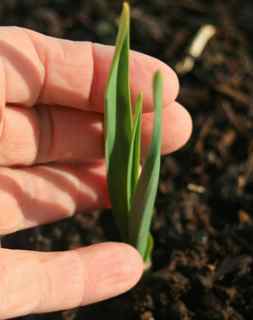
Garlic shoots in March

In early March, Garlic shoots stood just a few fingers high, but were starting out strong. This is when I did my first major weeding.

It should have been done before the equinox – so if you were on top of things, Bravo! Yes! Plant more sweet peas, spinach, salad greens, kale, chard, beets, broccoli, berries, shrubs, trees, and the many of their kind who love to get a good start before the heat arrives….

But – if you didn’t get the Round To-it, here is the deal:

Early Spring is the most important weeding you will EVER DO in your garlic bed.

Bold & Italics-type Seriously.

Why?

  • Because the tender, brittle roots have not yet extensively spread throughout the soil – so weeding now is less likely to break them.
  • Because the weeds, too, are just getting going – and although some may seem quite large already (especially grass and dandelions) – it’s nothing compared to how quickly they will soon get a grip in the soil, at which point, they may be impossible to remove without damaging the garlic.
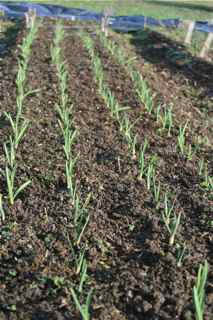
    Garlic Shoots in April

    Same garlic, one month later. It’s already over a foot tall! It could use another light weeding. There are some signs of frost damage. But hey – it is obviously ready to jump for the sky! Give it a boost with a little fish fert or kelp. Blood meal is also good.

  • Because the chickweed, for example, can easily be pulled out, but will soon go to seed and be all over the place (eat it – you’re not weeding; you’re harvesting).
  • Because if you applied mulch, you have to get it off there pronto so the ground can dry out and warm up (or you risk getting the dreaded MOLD) – and while you’re at it, you can clean things up.
  • Because everyone is beginning the competition for nutrients – and you need to help your garlic by eliminating (or at least reducing) the competition. They can’t do it on their own. Indeed. You DO have a purpose.
  • Because the garlic is now a hungry green vegetable – and Now is the best time to give it more nitrogen, kelp, and fish fertilizer. Healthy green leaves now mean bigger bulbs later. It’s important. Really important.
  • Because the last thing you want to do is fertilize a bunch of greedy weeds determined to dominate the universe! Get them out of there!

So – Go for it. Pull back the mulch if it’s there. Weed that garlic. Give them some food. Tell them how proud of them you are for getting through the winter. It doesn’t mean that easier days are ahead, though. There are more weeds out there that want to steal their food and water and strangle them out of existence. There are incessant natural forces of wind, rain, and blistering heat. After they survive the elements, they are lifted out of the comfort of the soil and are left to desiccate in dry air. Lastly, they are chopped into tiny pieces and outright eaten with great relish by ravishing beasts. Such is life.

While you are lovingly nurturing these tender (yet sturdy!) sprouts, don’t tell them that last part, mmm-kay?

Time to Plant Garlic!

Yes, NOW is a perfect time to plant garlic in the Pacific Northwest, and my guess is, if you haven’t planted them already, you have some voluptuous bulbs in your hot little hands just waiting for the right conditions to take root. You are faced with a serious dilemma. Will you tuck them in the ground for the winter and encourage them to be all that they can be?  – or – will you just eat them right here and now because, for Criminy sake, they are just knock-out gorgeous and who can wait ‘til next summer? And then will you get on a tangent about the word Criminy and wonder whether anyone even says such a thing anymore (or whether it even matters?) Meanwhile, the sun is going down earlier and earlier…and it looks like rain….

Believe me, I have been there.

It’s perfectly ok to be confused about what to do or not and be almost paralyzed with indecision stemming from a desire to do it right – I mean – this is your whole crop for next year and beyond, so you don’t want to screw this up!  I’ve been growing garlic for – good grief! – about 35 years, and all I can say is, Every Year Is Different. I am still confused, but dazed and confused is a way of life for me, so I’m rather used to it.

But seriously, friends, I am here to make your life easier.

Despite what some might call a handicap but which I might better describe as intermittent inspiration, over the years, I’ve written an assortment of ideas on what has worked and what has been a total disaster for me. You might find these wanderings helpful – and in this spirit of trying to make things easier for you, I have listed the links below. (Of course, you could just do a little search and a list of these blog posts would magically appear on your screen – but you might not be able to tell by the title and the first few lines just where things are going. I certainly didn’t know myself when I wrote them.)

If you’re looking for straightforward, clear instructions, um, you probably won’t find it on these pages. There are plenty of other websites for that. I mean, how hard can it be? Just stick it in the ground, root end down, pointy end up, and cover up with about 2 inches of dirt. Why do we have to make things so complicated? However, if you enjoy laughing at gleaning from other’s mistakes, embellished with a story or two, you might find just what you’re looking for and a little bit more.

Fully adjustable hole maker for planting garlic

Fully Adjustable Handy-Dandy Garlic-Planting Hole-Maker Gizmo

And if you’re a sucker for cool tools (and who isn’t?), check out our new handy-dandy garlic hole maker. If somebody wants one of these, we’d be glad to make you a nicer one. This one was made from what we had laying around (the most expensive part is the hardware). I still have the first prototype that is set at 6” spacing; however, in this new & improved model, the spacing is fully adjustable. (This year, I am spacing the garlic slightly wider at 8” down the row and 10” across. I figure the wider spacing will give them more airflow, which might mean less chance of the rust I dealt with this year, and also more space for them to reach out for the good things they love in life: food, water, and, like all of us in the rainy Northwest, sunshine). This thing makes the whole process go a lot faster – and everything pops up so straight and even – even when you plant them in circles and trapezoids!

And if your brain is in tangles trying to figure how many extra cloves you might be able to cram into a space if you vary the planting distance an inch or so or how much space you might need with xxxx number of cloves … may I refer you to the Garlic Planting Calculator in Excel that has formulas all set up that allow you to test different scenarios. Simply make your changes in the GREEN squares and everything miraculously adjusts accordingly! I just love magic.

One final word of advice – always plant more than you think you need, because something always happens! And if you end up with extras, sharing is a great way to make friends.

If you need more seed, contact me. I still have some Brown Tempest, Chesnok Red, Juan de Fuca Wonder, Killarney Red, Metechi, Romanian Red, Siberian, Siciliano (small ones), Vekak, and Ziemiai (also small ones).

And now for the links:

Garlic Garden Planning

Garlic Planting Planner (an introduction to what it is and what it can do!) 

The Not-so-Secret Formula: Excel Garlic Planting Guide

Self-Imposed Limitations, Sustainability, and Creatively Breaking Rules

Is Your Garden Boring? The Food Forest Solution

A Somewhat Unconventional Garlic Garden

Strategies for Success

25 Garlic-Growing Management Strategies for Preventing Problems and Growing the Best Garlic Ever

Every Soil Tells a Story

When All Else Fails, Buy Plants

Garlic Varieties

Barbolian Garlic Varieties

Planting Garlic

Time Again to Plant Garlic

Yes! You Can Still Plant Garlic!

Bulbils

Planting Garlic Bulbils for Fun and Profit

How to Plant Garlic Bulbils

That’s it for now, folks – I’ve got to get mine in the ground, too! Hope this helps in your yearly quest for a bountiful crop of better garlic!

Well, you can’t stop the rain, bring on more sunshine, or turn down the heat on a scorching afternoon – and I can’t tell you how many times I’ve irrigated only to have some unforecasted system bring more water to an already wet field. Add stressors of wind, continued cold weather, and then a sudden summer heat that creates a warm wet soil, and the next thing you know, the fungi are multiplying and attempting to take over the underworld.

Fungus, mold, viruses, maggots, disease, rot – these are the insidious organisms, their companions, and their effects that, as garlic growers, we all must face, even though they are invisible until it is too late.

What is a poor gardener with only a hoe in hand to do?

Actually, there are quite a few things you can do, and I am here to suggest 25 tips – and this is just to get you started!

The time to plant garlic is NOW through November, depending on your location and climate (I usually plant around Halloween here in Zone 8b). With a little forethought and planning, you can minimize the chances of your garlic garden of paradise descending into a den of decay. However, you need a strategy – one that will guide your garlic through the seasons of its life, from tiny sprout to its final epicurean adventure – one that will ensure your plants will be strong enough to withstand the onslaught of nature and all its nefarious beasts along every step of the journey. Are you ready?

Where to Plant

  1. Plot RotationRotate your crops on at least a 3- to 4-year cycle. This is the first rule. I have rarely planted garlic in the same place twice, but that presents its own set of problems (i.e., always thinking ahead and building soil in new places for the following years).
  2. Build the soil with compost and manures. Lots of organic matter is good. Bulbs tend to grow a bit deformed in clay soil (believe me, I know). “Sandy loam” is often the mantra, but too sandy can also mean too dry (believe me, I know this scenario, too). Grow green manures; turn them in or chop & drop over time. Well-composted manure can add beneficial microorganisms; however, watch out: if it’s too hot, it can burn the garlic while making the environment nice and warm for molds, nematodes, and unwanted destructive guests (double whammy!).  Llama manure is not hot; in fact, weed seeds will go right through the gut and out the other end, unfazed. I have effectively planted grass all over my garden with the use of llama manure. A balanced, well-composted compost is best.
  3. Add other soil amendments as needed. The garlic produces strong roots over the winter and the majority of its leafy green growth in the spring. Bone meal is often a good amendment; garlic likes the extra phosphorous. Adequate nitrogen is also important; if you add it, make it a slow-release type. Our northwest soils usually benefit with a bit of lime.
  4. Test your soil before planting! Have you thrown together a cocktail of nutrients in the soil and don’t know how potent it is? Such an easy thing to do. Optimum pH is between 6.2 and 7.0. Liming is recommended below 5.8. Garlic is tolerant of pH up to 7.5.
  5. NPK_pH testLiberate the NPK! Nitrogen, Phosphorous, Potash/Potassium – believe it or not, you might not need to add anything to your soil. Maybe all it needs is aeration, good drainage, and the good kind of microorganisms that allow the nutrients to be better absorbed. It’s kind of like finding out you have osteoporosis. Swallowing a bottle of calcium pills isn’t going to change anything if you can’t absorb it.
  6. Encourage microbial growth. (What? I thought they were our enemies!) Actually, it’s good guys vs. bad guys down there, and your job is to make the environment rich for the good guys to win. When you build the soil and fertilize your plants, you are actually feeding microbes, mycorrhizal fungi, protozoa, bacteria, nematodes, and their associated friends, which, in turn, feed and protect your plants. Here is an interesting factoid (from the Ohio State University Extension research): there are more microbes in a teaspoon of soil than there are people on earth! I’m not sure which census the researchers were using, but it’s a little mind-boggling to think about how many teaspoons of soil you might have in your garden! Clearly, we are outnumbered. There’s a lot going on down there. Bacteria are consuming nitrogen, carbon, and sugars; nematodes and protozoa, in turn, are consuming bacteria and releasing nitrogen in the process; fungi are breaking down carbon life forms and transporting minerals to plants; plants are doing their photosynthesis thing and delivering sugars to the fungi; everything is producing waste products (nitrogen/ammonia), which can be absorbed by the plants. (Whew! Do they ever sleep??) Our best strategy is to make them our allies and NOT eradicate every living thing with massive doses of diluted Agent Orange. They don’t just need NPK; they also need oxygen, hydrogen, sulfur, copper…an assortment of minerals and nutrients not found in bags with NPK labels. They need CARBON. Your best bet? Yep. Good ol’ compost. Cover crops. No-till non-disruptive practices. Books are written on this stuff. And blogs.
  7. Do not plant garlic in places following cereals (wish I’d known that before planting rye as a green manure crop). Apparently, cereals are hosts to the Fusarium (Basal Rot) fungus (see http://pnwhandbooks.org/plantdisease/node/6043/print). That said, I must also say that I’ve had great success with rye as a cover crop, even though it is reported to have slight allelopathic properties, and can be somewhat difficult to eradicate, especially if it goes to seed. On the other hand, it produces good mulch material, and I am making a mental note to grow more of it expressly for that purpose.
  8. Engineered raised bedBuild raised beds to ensure good drainage (and remember the earlier comment on too sandy of sandy loam). Raised beds are also warmer. They are the first to sprout weeds in the spring. Especially those facing south. The garlic, too, appreciates that added warmth.
  9. Think ahead! (see tips #1 and #2) Plant cover crops for where you will plant next year’s crop (and the following, if you can). A mix of clover, vetch, and rye is good; buckwheat is also good, but doesn’t survive the winter; favas, fabas, and assorted peas will add nitrogen; a variety of crops at different times will give you a variety of nutrients. Cover crops provide a smorgasbord for the friendly microbes (tip #6). Keep ‘em happy and your plants will be happy, too.

Seed Stock

  1. Know your garlic. Or better yet, know your garlic farmer. Even better, HUG your nearest garlic farmer. Seriously, there are simply not enough hugs exchanged in this world! But when it comes to garlic, if it’s not your own seed (and I have kept my Juan de Fuca Wonder strain going since 1976!), buy from someone you can get to know, even if it’s online. Have you thought about your local Farmer’s Market as a seed source? Even if the bulbs are rather small, you can size them up over time. Local bulbs will already be acclimated to your growing conditions.
  2. Avoid grocery store garlic. Grocery store garlic comes from that vague “somewhere” out there (often China) and is often treated with “solutions” to prevent sprouting – not the “solution” to your what-to-plant question!
  3. Select an assortment of varieties to spread the garlic love over a longer time. Different garlics mature at different times, have different flavors, are best used in different ways, and have different storage capabilities. If you do it right, you could never be without garlic. Hold that thought!

Pre-Planting

  1. Seedstock garlic cloveSelect your biggest cloves for planting. Bigger cloves make bigger bulbs.
  2. Inspect your cloves for any kind of blemishes, bruises, marks that might indicate critter or fungal damage. Minimize the chance of pathogens, spores, nematodes, & all the etc. out there. I have been known to eat these substandard cloves, because I hate to see garlic go to waste (or anything else for that matter). I let my stomach acids take care of them. I’m still here to say it works.
  3. Give your cloves the hot water heat treatment before planting. The trick is not too hot, not too cold. Soak them in water at about 115-118 degrees for 15 or 20 minutes. Nematodes really hate this.
  4. Soak the cloves for a few hours (some say overnight) in a solution of 1 T liquid seaweed & 1 heaping T of baking soda in water. Some people also add molasses. I have done this for several years, and it makes sense to me. A bit messy, but I tend to be messy anyway. Then one day an older guy came to buy some garlic, saw my assorted bowls of cloves swimming in dark broth (imagine 24 varieties and over 1000 bulbs), and could hardly suppress his laughter. Why would I go through all this hassle? I gave him the standard intellectual explanation, to which he just shook his head. It was kind of a “whatever” moment. So last year, I just stuck the cloves in the ground – no fuss, no muss, the way people have been planting garlic for centuries, and wow, it really streamlined the whole planting process. Result? I had quite a few mold problems this year. I threw a lot more away. But then, it was also a cold, wet year. To be honest, there are so many variables, I don’t know whether it works or not, but I’ll be doing the soaking thing again this year. For sure.
  5. Dunk the cloves in rubbing alcohol (or Vodka – but is this the best use of Vodka? You decide.) for about 15 seconds (some say a few minutes) before planting. This has got to be the final blow to anything left thinking it can hitch a ride to your soil.

Planting

  1. Plant your cloves soon after popping. Don’t give them time to wither or mold or even complain about it.
  2. Be careful not to bruise or wound the cloves. It’s ok if the wrappers fall off – they will anyway – and it gives you a chance to look for signs of insect damage, bruising, or the slight crease that would indicate a “double” clove. (It’s ok to plant the double cloves, but you will get a double bulb in return, i.e., two small ones connected together instead of one large one. Most commercial growers prefer single large bulbs; they sell better. Home gardeners? Most aren’t going to base their self-esteem on the size of their bulbs. It’s all good.)
  3. Planting GizmoPlant your cloves at a wider spacing. Four inches, in my opinion, is too close. Six inches is better, but might be too close in your circumstances. You might want to try eight. A wider spacing can give the roots more room to spread out and find water and nutrients, resulting in a stronger plant. I used to figure that a 3-inch-diameter hardneck bulb would only need 4 inches of space (of course, softnecks grow a bit larger and would require slightly more). I no longer think that way.
  4. If you’re planting in raised beds, be sure to allow extra room on the edges! Seems so obvious, but I can’t tell you how many times some of the soil has washed or sloughed away, or when I pull weeds, more dirt has fallen away than expected, exposing roots & bulbs. Talk about stress!
  5. Plant the smallest cloves tightly together so you can harvest them in the spring as “spring garlic.” Eat them like green onions, only garlicky. This goes with the strategy of ensuring you are never without the garlic supply that by now you realize you truly need.
  6. Mulched Garlic BedIf you use mulch, do not use hay or grass, which can plant seeds all over the place. Dry leaves are nice until the wind comes up and blows them all away.

Caveat and Perspective

  1. Enjoy positive thoughts! Your garlic is in the ground. Congratulations! Relax and feel relieved. All you have to do from now until spring is to kick back and scan colorful seed catalogs. (Ha!) Feel hope! The excitement and anticipation of a great garlic crop to come is a good feeling! Hang on to that! Use it to motivate you to get out there and weed on a half-warm day in mid-winter (i.e., ignore that naïve comment about kicking back – the weeds in the Pacific Northwest never kick back, and neither should you!)
  2. And lastly – Remember – you are not always in control (i.e., ignore that previous comment that suggests you can get out there and slaughter all those weeds. From the weed’s perspective, such a minor setback is only reason to grow stronger!)  The reality is, the soil is full of organisms of all kinds. Some live in the soil; others float in on the air; others ride in on the water. Some are “good” and others “bad,” but only by our perception. Some things simply can’t be avoided. Despite the mix of good years and not-so-great years, look for reasons to celebrate – with garlic, of course – and friends! Exchange hugs while you’re at it!

(Let’s see – that’s 9+3+5+6+2 = 25 tips! Hooray!)

P.S. Click on the images for more info!

What’s Wrong with My Garlic?

Call in the Garlic Whisperer!

Basal Rot

Basal rot on garlic; University of Minnesota Extension photo

If you grow garlic for any time at all, eventually you will have “issues.” At some point along the way, you might notice that some aren’t doing quite as well as the others. Maybe you notice a little discoloration or wilting, but overall, most seem to be holding their own against rain, wind, and heat. Or maybe, much to your surprise, a whole bed will turn yellow and fall over, seemingly overnight.  On the other hand, maybe everyone appears to be doing just fine, the leaves turn yellow in summer, indicating time to harvest, but when you dig them up – agghh! The Dreaded Black Spot! Maybe even white fuzz, malformed bulbs, stunted roots, creepy-crawlies, or any number of other things. Or maybe they all look beautiful, you proudly hang them to cure and are ecstatic at the wonderful crop, but then a month later, they become soft and show signs of decay.

Many will tell you growing garlic is easy – but the truth is, it is a long, tricky process, and you – or nature – can screw it up any step along the way. By the time you notice something is wrong, it can be too late.

Don’t thrash yourself too harshly. Some things you simply can’t avoid. They are there. But you spend 9 months pampering these sweet babies into healthy, strong individuals, and you want to do what you can to ensure they grow up to their potential. I am a strong believer in unconditional love, but there are also times when tough love is warranted. However, paying attention, listening, and a little preventative care can go a long way to avoiding problems down the line.

It’s a Bit Like Fortune Telling: We Have to Learn to Read the Leaves

Garlic leaves affected by Fusarium; University of Minnesota Extension photo

Garlic leaves affected by Fusarium; University of Minnesota Extension photo

Garlic speaks to us through its leaves – so if we want to understand garlic, we can divine knowledge of its well-being or malaise (and correspondingly, our upcoming fortune or otherwise) through leaf interpretation. Divination requires two things: a question and an answer. The real question, of course, is whether it’s the right answer, what does it mean, and what is your subsequent response. I guess that’s four questions. No matter. Life rewards action.

For example, the standard advice on when to harvest garlic is to look at the leaves. When the bottom leaves start to brown but 3 or 4 green leaves still remain (some recommend 5 or 6, but not every variety has a lot of leaves), the time is right. Each green leaf represents an associated wrapper that can protect the bulb after it is harvested, so you want to make sure you have a few green ones left.

Yellow tips are such a common garlic phenomenon that many consider it “normal.” They can be caused by any number of stressors: a hard winter, a warm spell followed by a freezing spell, mild nutrient deficiencies or imbalances, too much or too little water; a little of this and that. I don’t worry about yellow tips. My garlics usually get them. Everything I read says that unless they are extreme, yields should not be affected.

However, yellow stripes, splotches, speckles, leaf curl, thickened leaves, purple veins, or other abnormalities indicate something more serious is going on: soil deficiencies, insect infestations, fungal growth.

Multiple shoots coming from the stalk might be from cold damage in early spring.

Severely stunted, crumpled bulbs in spring might also be a vivid complaint about a rough winter or early spring freezes. Stunted plants might also indicate the presence of thrips.

Wilted leaves during mid-season: your plant might just be thirsty. Be aware that under-watering can cause the plant to mature early. Or maybe it’s just tired and hungry, in which case a little foliar or root-zone feeding might bring it back around. Then again, perhaps something more nefarious is lurking beneath the surface, and further investigations are warranted.

I used to think that garlic was an invincible super plant. After all, it is used as an insecticide, fungicide, plant strengthener, immune system booster, and it provides a number of health benefits to our homeo sapien brethren. What could possibly hurt this remarkable plant?

As it turns out, Plenty! The following is a quick summary of several of the fungi, insects, and other stressors that can affect the garlic crop. After compiling this list, I am actually quite amazed mine have done as well as they have over the years!

Mold & Fungus

Garlic White Rot (Steve Renquist photo)

Garlic White Rot (Steve Renquist photo)

Aaaagggh! If you live in the Northwest, mold happens. Every year I find some – some years I find a lot. We’ve had one of the coolest, wettest spring & summers on record – conditions that would make any fungus happy – so don’t be surprised if some of your beloved garlic plants fall prey. Sometimes you can’t tell what’s going on – the plants look basically fine, maybe the leaves start to yellow, which they normally would anyway – maybe some seem a little smaller, but variations in size are common – and then you go to harvest the plant, and you find the dreaded mold. Roots that are rotted off are a sure-fire sign, as is black around the neck. I have had cold, wet years when I’ve lost most of my crop. Sometimes it’s isolated to an individual area, in which case I take a closer look at soil differences, watering techniques, or microclimates that could cause problems. These bulbs need to be thrown in the burn pile (do not compost!), and it’s a sad day. I have, in desperation, rubbed off outer skins and thrown clean cloves into vinegar for a fresh pickled garlic, but they are never as good as the cured kind. Here are some specifics:

Basal or Bottom Rot (Fusarium culmorum and F. oxysporum): This fungus is pretty much in all soils but is usually not a huge problem unless the plants are already weakened by some other stressor. It is most frequent in warmer temperatures, like late in the summer. Look for reddish decay in a single clove or the entire bulb. Yellowing begins at tips of leaves and moves down; plants may wilt; rot appears at the basal plate. Bulbs might appear ok but then rot during storage. It looks a lot like white rot, but death proceeds more slowly. If conditions are not ideal, it may not be that obvious that it is even there – but then, during storage, if temps are relatively warm, the bulbs may begin an early decay and the cloves shrivel into tough little inedible nuggets.

Blue Mold (Penicillium hirsutum and P. corymbiferum): The Penicillium Rot travels through the air and shows up as a blue-green mold on wounded garlic. It can happen in the field, where they emerge but then turn yellow and die, but it particularly occurs after harvest during storage as a result of rough handling. Be careful not to plant infected bulbs or you will get it again. It’s easy to do. One little infected clove in a bowl of popped cloves ready to plant can infect the whole bunch. If you see mold on a bulb, don’t think you can plant the “clean” cloves. They are not. Spores are invisible.

Downy Mildew (Peronospora destructor): “Destructor” says it all. It likes cool, damp/wet weather. Spores can be wind-blown over long distances, and they can even “swim” via rain and irrigation. They just love it when the weather is around 55 degrees, which it is for most of our spring and summer. The pathogen survives as oospores for many years in the soil. When the weather turns hot, the plant can regain the upper hand, but if it turns cool and damp again, the Destructor will return. It can reach epidemic proportions under the right conditions. Look for spots on the leaves that become covered with a grayish furry mold. Growth is stunted; younger plants may die; outer scales of bulbs become water-soaked; necks sometimes shrivel and turn black. Yuck.

Leaf Blight (Botrytis squamosa): Look for grayish-white leaf spots that become brownish. Usually occurs under high humidity, moist conditions.

Neck Rot (Botrytis allii and B. porri): This fungus survives on dead plants in the soil and attacks garlic leaves in warm, wet weather. It will also take over the bulbs in storage. It is called “neck rot” for good reason – the stem turns black and slimy and easily pulls from the bulb. It can be quite common in maritime climates, and usually affects the softnecks more than the hardnecks. Watch for sclerotia, those black clumps that form between cloves. Excessive rain or irrigation can encourage growth, and it is difficult to control in wet weather. I have had to deal with this in wet years when mulch and compost kept the moisture levels high in the soil and directly around the bulbs, and also when weeds (large dandelion leaves!) limited air circulation around the plants. Be careful not to bruise the bulbs, which can also invite infestations.

Rust (Puccinia allii): The rust fungus travels with the wind and loves cool, wet conditions. High humidity, low rainfall, temps between 45 and 55 – oh, yikes – that’s exactly what we get here! Look for yellow flecks and spots that turn to orange and brown. The only real controls involve chemicals. Fortunately, according to CA studies, although overall yield may be reduced in heavy infestations, you can still use the cloves for planting in the following year. Rust was a problem for me this year, which I will discuss in a future post.

White Rot (Sclerotium cepivorum): If you get this, you might as well give it up forever, because this fungus can live 30 years in the soil and is particularly active in cool, wet conditions. It looks a lot like basal rot but the garlic demise is much more rapid. The bottom leaves turn prematurely yellow, along with the leaf tips; the plants fall over and the stems and bulbs begin to rot; the plant pulls apart; roots are rotted; you can see fluffy white mold and poppy-seed-sized black sclerotia, which are smaller than what you’d find on neck rot. The sclerotia germinate in the presence of sulfur, which is produced by the garlic plant. How convenient for them.

Viruses

Yikes. “Virus” is such a scary word! It conjures up images of the plague sweeping across a field of posies and we all fall down. However, according to the U of MN: “Because garlic is clonally propagated, almost all [italics mine] planting stock is infected with some type of virus. The viruses are usually mild and do not seriously affect yield….One exception is onion yellow dwarf virus, which can cause severe mosaic in combination with other viruses. Most of the garlic purchased from seed catalogs and other garlic growers contains some virus.”

Garlic Mosaic (also onion mosaic): Look for mottling or striping on the leaves. Mosaic is caused by several different viruses that appear to be lumped under the “potyvirus” term. They can be transmitted through the planting stock or even carried by aphids. It is thought that these viruses are commonly present in all garlic (according to U of CA).

Iris Yellow Spot is a virus carried by onion thrips. It is usually seen on onions, but can also affect other members of the Allium family. Identify by a diamond-shaped splotch on the leaves or elongated brown lesions.

Yellow Dwarf Virus: Look for yellow streaks on the leaves. Not all leaves are necessarily infected, and how much it affects the crop depends on the level of infestation and the time of the season – a mild infestation late in the year might have very little effect. Stressed plants are more likely to get it – or maybe they have it all along, but a weakened plant under the right conditions allows the virus to manifest itself. In severe cases, plants are stunted; leaves and flower stalks can be twisted and pale. Of course, yellowing leaves look like just about everything else that can affect garlic, so it’s hard to tell whether it’s really the result of the evil Yellow Dwarf or not. Preventative measures are best.

Critter Infestations

Damage from Onion Thrips

Damage from Onion Thrips (University of Maryland Home & Garden Information Center)

Aster Yellows: I put this in the critter category because it is carried by a leafhopper bug.  Signs include smaller, yellow, deformed leaves (veins remain green) and a possible “witches’ broom” appearance. The disease is relatively new in garlic, particularly up north, but I recently heard of a grower in Minnesota who lost 10,000 bulbs to this pest! What a devastating loss! Aster yellows can actually affect over 300 species of plants and is caused by a phytoplasma. When the leafhopper feeds on the plant, it becomes infected for the rest of its life. The spread of aster yellows is worse in cooler, wet climates, probably because leafhoppers don’t like hot dry areas. One has to wonder what kind of pests and diseases we will have to deal with in the face of climate change – those things that might migrate north to escape the heat and drought.

Nematodes (Ditylenchus dipsaci) can live in plant tissue for 9 years! They spread through planting infected seed stock. Plants may show no symptoms in cool growing conditions, but in warmer weather, the tops will yellow prematurely. In some cases, the stem will appear stunted or twisted or even swollen; sometimes the bulb is deformed. Look for swollen tissue at the basal plate, spongy tissue, splits where you’d normally see a bulb, yellowed skins, rot and decay. (Not to be confused with the predatory nematodes, Steinernema feltiae, aka Neoaplectana carpopapsae, which you can actually purchase, and which are known to attack some 250 or so different kinds of insects, worms, and bugs.)

Onion Maggots (Hylemya antiqua): These legless little white maggots will bore into the garlic stem underground. The plant will turn yellow, wilt, and possibly die. They generally prefer onions and shallots. As an adult, they look like a little grey housefly; eggs are laid at the base of plants in the soil; the baby maggots have voracious appetites.

Onion Thrips: These little suckers love warm, dry weather. Look for whitish specks on leaves (lack of chlorophyll – they suck the life-blood juice right out of the plant) that grow into splotches and eventually all run together. They can hibernate in the bulb wrappers and carry viruses, such as the Iris Yellow Spot mentioned earlier. Oh – and if you live in a warm place, you can have 10 generations of these buggers in your field in one season alone!

Soil & Other Issues

Punky Bulb: Seriously, Dude, this is a real thing. It is caused by a manganese toxicity due to a low pH. Cloves are loose and discolored.

Waxy Breakdown: The cloves turn translucent and rot. It can happen when the temperatures are hot during harvest (sun-baked?).

Nutrient Imbalances: Lack of nitrogen, potassium, calcium, magnesium can all appear like everything else – yellow tips of leaves, often affecting the oldest ones first (calcium deficiency often appears as spots). Leaves die back. In nutrient overloads, for example, too much nitrogen, you might see excessive side shoots. Test your soil. The best preventative approach is to build the soil in a balanced way through compost; applying boxes of this and that can really throw things off.

Conclusions:

I don’t pretend to be an expert here. By all means, if you suspect something wrong with your garlic, look for additional resources, talk to experts, consider having your garlic, soil, or whatever you can catch tested. In my next post, I will talk about management strategies and prevention. In the meantime, here are a few good sources of information.

Some Resources:

Anderson, Bob. “Gourmet Garlic Gardens” (website for all things garlic). http://www.gourmetgarlicgardens.com/diseases.htm

ATTRA – National Sustainable Agriculture Information Service. Updated 2008. “Garlic: Organic Production.” 28 p. https://attra.ncat.org/attra-pub/summaries/summary.php?pub=29

Cornell University Dept. of Plant Pathology & Plant-Microbe Biology: Diseases of Garlic http://plantclinic.cornell.edu/factsheets/garlicdiseases.pdf

Engeland, Ron L. 1991. “Growing Great Garlic. The Definitive Guide for Organic Gardeners and Small Farmers.” Filaree Productions, Okanogan, WA.

Oregon State University Extension. “An Online Guide to Plant Disease Control.”

Oregon State University, Washington State University, University of Idaho. “Pacific Northwest Plant Disease Handbook,” a Pacific Northwest Extension publication. http://pnwhandbooks.org/plantdisease/

Pacific Northwest Plant Disease Handbook http://pnwhandbooks.org/plantdisease/

University of California Integrated Pest Management http://www.ipm.ucdavis.edu/PMG/selectnewpest.onion-and-garlic.html

University of Minnesota/Extension. “Growing Garlic in Minnesota.” http://www.extension.umn.edu/distribution/cropsystems/DC7317.html#diseases

University of Minnesota/Extension. “What’s Wrong with my Plant?” http://www.extension.umn.edu/gardeninfo/diagnostics/vegetable/garlic/index.html

Disclaimer: Each of these resources contains valuable information; some present info on chemical controls, which is not something I myself use, but I do find it useful to know what might be applied on crops where chemical warfare is supported.

Garlic: You Better Come On In My Kitchen

…because it’s gonna be rainin’ outdoors….

and now it’s gone, but I ain’t worried, cuz I’m settin’ on top of the world….

(Thank you Robert Johnson and the many others who have done versions of these songs.)

Yes, it’s been awhile since I’ve played harmonica for the ol’ garlic patch (or at least shared it). We are bringing her into the kitchen for her own protection… bwahahahaha

Garlic Status: Mid-July

I am getting lots of questions about where we’re at with the garlic – when we’ll have bulbs for sale – and how about the bulbils?

Here’s my final, not-so-final, wishy-washy answer to predicting the future: I’m not quite sure.

Most years, I’d have the crop in by now. Last year, though, I was harvesting late July and into August, a full month later.

This year seems similar to last. We’ve had some unusually wet, cold weather. I felt sorry for the folks at the “Sunny” Sequim Lavender Festival this last weekend — I don’t think the temps even reached 60 degrees! We’ve had more thunder and lightning than I’ve ever seen on this side of the mountains, and one downpour after another, interspersed with what seems like eternal drizzle. Combine that with winds gusting to 40 and 50 mph, and most of us are tired of saying, “Summer is just around the corner.”

How is this weather affecting the garlic? I am sorry to say I’ve already had a few failures this year – a lesson in microclimates within the garden (I am always learning!) But other varieties are looking really good, despite what are ideal conditions for fungus and mold outbreaks.

Conventional wisdom says to cut the watering a couple of weeks before harvest, but good luck stopping the rain! The fact is, bulbs can increase a lot in size during those last few weeks in the soil, so I have been holding out as long as possible for that promised warm weather to help them along. The question is, will we then have even better conditions for mold (wet, warm soil)? Time will tell, and I am keeping my fingers crossed. I am thankful for raised beds and soft soil (and ok, I admit, even a little breeze now and then – just not something that takes down the schooner Hesperus!).

When to harvest is always a tricky question. Usually I harvest when the bottom leaves are dying off, leaving green ones at the top, and when the scapes show signs of maturity. I am seeing dying leaves – but the scapes are still young. For example, the other day, I went ahead and harvested the Persian Stars, a beautiful little purple stripe, but I think I really should have waited a little longer. They are in good shape, but perhaps not the size they could have been, and I don’t know that the seedlets in the scapes will be mature enough to sprout. We will have to test them.

Final guesstimate:

  • Harvest late July / early August
  • Cure for 3-4 weeks after that
  • Sell & ship in September onward (earlier if you want to stop by and get the green stuff).
Will keep you posted! Thanks for following!


How is your garlic growing?

German Extra Hardy garlic plants

Short person in tall garlic patch. That would be me and the German Extra Hardies.


Plant Survey:

About once or twice a month, I am taking a photographic survey of plants in the garden and around the back acre. The camera is such a wonderful tool for documenting what’s going on out there in the weed jungle. I will later transfer this info to a spreadsheet where, for example, I can chart the blooming times of different plants to better see what is available to the bees at different times of year. It also makes an easy way to look at when things are ready to harvest (and plan accordingly, which is key, and which I learned the hard way when the black mustard was ready at the same time as the garlic and there was not room for both to hang in the shed!). Course, some of the plants don’t look like much yet (which will make it all the more interesting when the back acre is magically transformed into a food forest / combination wildlife habitat corridor). But other plants, like this year’s garlic? Holy Toledo!

Love how the camera gives us perspective! You may remember how it used to look:

New garlic beds

Garlic Maze – late October 2011

People thought I was crazy, for sure.

And again – the “After” – same spot.

Garlic Maze on Memorial Day 2012

Garlic Maze today

People still think I’m crazy. Oh well.

Nettle Soup

Stinging nettles

Nettles. (Photo from NorthernBushcraft.com)

I love foraging. I love the idea that there is all that food out there just free for the gathering. This is a perfect time of year for foraging, because a little bit later, many plants turn tough and bitter. Nettles and dandelions, for example.

So – for today’s wild feature: Nettle soup.

Those who read my blog know that I’m a freestyle cook who throws things together never the same way twice, depending on what is at hand. So here, more or less, is what I did:

Basically – take your favorite potato-leek soup idea and add nettles. How hard is that?

Ingredients: nettles, potatoes, a leek, a couple stalks of celery, soup stock (chicken would have been good, but I had some beef bone broth available), a handful of French sorrel, a little lemon juice, bacon (optional), garlic, salt & pepper, and kefir, yogurt, or sour cream to decorate the top. Don’t worry – you don’t have to have all of these – except the nettles, of course.

Here’s what to do:

  1. Collect the nettles. Yes, first you have to pick the nettles and be reminded why their full name is “Stinging nettles.” Emphasis on sting. Wear gloves. I used to know someone who could take a handful of them and rub them on her face with no ill effects, but I have no desire to do something crazy like that to impress my friends with my daring stupidity. I have found, though, that if you pinch them directly on the leaf, no problem. It’s when you brush lightly past them that you break out in a rash, which is something I will remember the next time I decide to go running naked through the edge of a field. Just kidding, of course. Sort of. However you do it, get a bagful, because they cook down like spinach. Personally, I collected 2 bags, cutting them off at mid-stem so they would grow back – one for the soup and one for drying to make tea at a later time.
  2. Cook potatoes: boil up 5 or 6, depending on how big a batch you’re making. Make this pan the one you want your final soup in.
  3. Cook bacon: optional item – but we get this really good chemical-free bacon and if you’re a bacon fan, nothing more need be said. Drain it after cooking on a paper towel. Meatless friends, yes, the soup is good without it.
  4. Sautee the leek & celery in a little fat of your choice: oil, butter, bacon fat. Slice them up first; make sure you get the dirt out of the leek. I use almost the entire leek up to near the end where it gets a little too tough.
  5. Wash & cook the nettles. Mine were recently rain-washed, but I gave them another quick rinse just to make sure there were no bird droppings or bugs. Throw the nettles in a kettle with a little water & lightly simmer until limp – just a few minutes. Don’t bother cutting them up – just get them in there without hurting yourself. Boiling them takes away the sting.  Ok – it’s starting to look like you’re dirtying too many pans at this point. I admit, I really am a messy cook.
  6. Blend up the vegetables: Put the celery & leek combo in a blender. Add a little of the nettle liquid to the pan they were cooked in so you get those flavors off the pan. Throw that in the blender too, along with the nettles, stems and all. Also throw in a handful of fresh French sorrel if you have it and blend some more. Sorrels are high in oxalic acid, but it is neutralized by heat. They add a little tang and a lot of Vitamin C.
  7. Mash the potatoes. I used a separate immersion blender to buzz up the potatoes in their liquid, mainly because I didn’t have room in the blender – but it doesn’t really matter where you do it. The potatoes act as a thickener for the soup. Keep in mind you might want to add some soup stock later, so it doesn’t have to be super thin at this point.
  8. Combine all the veggies: potatoes, nettles, celery, leek, sorrel – it should look very green.
  9. Add some soup stock to thin it a bit: I am into making bone broths, so I added a cup of beef bone broth that was gelled solid with its natural gelatin. It’s extremely flavorful, full of minerals and vitamins, and melts in the heat. I often have a crockpot of bones simmering on the counter, so I usually have this handy. Chicken or vegetable would also be good.
  10. Crumble in the bacon (if you’re using it):  Everything else is pureed, so this adds a little chew-factor. Give everything a stir.
  11. Add a little lemon juice and salt & pepper: A tablespoon or so will brighten the flavors – and salt and pepper to taste, less if you added bacon. Mmmm, still needs a little something….
  12. Garlic! Chop up about 3 or 4 cloves: (hope you still have some!) Chop finely and let it sit for a half minute or so to develop flavors; then toss it into the soup. Give it all a stir. The heat from the soup will cook it just enough and not too much.
  13. Ladle into bowls and top with kefir, plain yogurt, or sour cream: I’ve been into making homemade kefir with the raw dairy milk from the Dungeness Valley Creamery down the road, so that’s what we used. We’re really fortunate to have a source of grass-fed cows and certified raw milk so close by! VERY much worth the extra price – this milk is a REAL food, and the nutrients are easily absorbed.
  14. Serve. Amidst “oohs” and “ahhs”. Very fun. Cost was hardly anything. Nutrient ratio out the roof.
Nettle Soup

Nettle Soup – a few weeds, some potatoes, and a dolup of homemade kefir – mmm!

We had a lot of family over that night and some went back for seconds.

Caveat: Since making this, I have read that potato water shouldn’t be used because potatoes contain hemagglutinins that disrupt red blood cell function, and those go into the cooking water. What can I say – we all survived.

Nettles as a Superfood

Nettles are seriously good for you. They provide protein, vitamins C and A, carotenoids, potassium, iron, calcium, thiamine, riboflavin, and niacin. They’ve been used as a tonic and a diuretic, applied to stop bleeding in open wounds, and slapped on bald heads to stimulate hair follicles and new hair growth. They’re a good source of quercitin, a flavonoid that inhibits the release of histamine; hence, they’re effective in treating hay fever and other allergies. They’ve also been used to treat arthritis, gout, urinary tract infections (the diuretic flush effect), and prostate issues; they’ve also been used to purify the blood and to cleanse the liver and kidneys.

Wow. I really do think I should be eating nettles more often.

Plus, they are a whole lot like pot, only they won’t get you high and they are legal. Ok, so maybe they’re not like pot. But – like hemp – they can grow 7 feet tall and be used as a fiber. They are extremely strong. This is good news. I used to do a lot of spinning (mostly dog and llama hair) – and I am definitely going to give nettles a try. They grow so fast and are so prolific, they even show promise to be used in biofuels.

You learn a lot of things on the Internet. I used to really like nettles, but I love them now. So much, in fact, I’m thinking of turning them into pesto.

One site I read said how the authors love to wrap stinging nettles around them because it makes them feel so alive and tingly.

Um. Ok.

Thanks, but no thanks. I might have to draw the line with that one. I think sex sounds like a better option if you’re looking for those sensations, and a heck of a lot more fun. Just my opinion.

Anyway – before we get sidetracked – bring on the Spring! Take a walk on the wild side. Collect things along the way. Throw them in a soup. Don’t forget some of the domesticated garden plants that are also at their best at this time of year. Cardoon, French sorrel, and lovage all come to mind. Each are rather strong-flavored in their own way, but are so good added in small quantities to just about everything.

And DO give nettles a try!

Won’t be long and the morels will be ready. Oh yes! Can’t wait!

Here are a couple of good sources for identifying your weeds and wild edibles:

Northern Bushcraft 

Westside Gardener


My garden is boring. I came to this realization one stormy day a year ago in February, a time when most plants were brown and shriveled, and only the weeds stood tall and green. I wrote about it in a blogpost about Self-Imposed Limitations, Sustainability, and Creatively Breaking Rules. I didn’t take pictures. I mean, how do you capture boring – and is that something you really want to share?

Being able to see the naked bones of the garden like that, though, can be quite an eye-opener – kind of like standing nude in front of the mirror and admitting you really should start working out (as in, something’s gotta change here). Course, we don’t notice it so much in the summer when everything is clothed in flowers. The worst part was, though, I realized it was not just boring; it was conservatively conventional, words that are almost blasphemy to my creative being.

Garlic plot rotation

Ah yes! Clean, neat rectangles. I DO love them! The garlic in this plot will be easy to take care of, if you like hard work. Back plots are planted with green manures. A very organized way of growing garlic on a small commercial scale. (And did I mention, very labor intensive).

Ok. I admit. My garden is very structured. Rows within rectangles within squares. Orderly. Clean. Neat. Ultimately linear. I stress over weeds. They disrupt the order.  A lot of people really like that sort of thing. It’s organized.

Other parts of my life? Not so much.

I was considered a bit radical back in the 70s when I experimented with the French Intensive methods promoted by early Organic Gardening magazines. I had recently returned from a stint as a foreign exchange student in Paris, so I thought I was pretty legit. My neighbors, though, wondered whether I had buried my dogs out there in the raised beds.

It might seem a bit odd, then, that someone who has long subscribed to the motto, “Question Authority,” never really questioned conventional wisdom when it came to gardening. Like canning peaches and making strawberry jam, certain things are passed down through generations, and they seem good just the way they are. Real good, in fact.

There is usually a good reason that things are done “the way they always have been.” Efficiency and convenience are two adjectives that come to mind: rows the width of a tiller, tractor, mower, or wheelbarrow. Ease of watering, weeding, and harvest. Knowing where things are might be important (ahm).

Crazy Person - Buy poster at Art.com with this link

Don't worry. This is just me going crazy. Thinking in circles and squares. And maybe a few triangles.

On this particular windy day that was shaking my belief foundations, however, I came to the “ah-ha!” moment when I realized that nothing in nature grows in rows. Like, duh. It’s more of an organized chaos. Now ThatI can relate to!

Looking at the weathered skeletons of the previous year’s vegetables interspersed with clumps of grass, it struck me that the difference between nature, a farm, and a garden is not just one of order and scale.

I also realized that my little backyard universe fell into the “none-of-the-above” category. Too small for a real farm; too structured to really be called a garden, which I think of as an artistic retreat expressed in a riot of colorful flowers (Tell me, why are a lot of colors always in a riot?).

Sure, we could call it a “hobby farm,” a term that I dislike because it sounds like a person doesn’t take it very seriously – and I am very serious about growing 24 varieties of garlic! But it’s basically too small for a tractor and it’s a lot of work with just a shovel. I have a lot of mixed feelings about a tiller, because it violently massacres worms, which are my friends, so I rarely use one.

Ok – so maybe the more appropriate term would be a “veggie garden,” which, in my experience, is traditionally a place of toil and trouble. These are tightly controlled spaces where people focus on succession planning and efficiency evaluations. It’s all about timing. Conditioning. Nurturing. Weeding weeding weeding. Harvesting. Processing. These words all sound like work to me, but at least you are (sometimes) rewarded for the effort.

And on the other extreme is nature — grand scale, everything grows, no work involved. The plants grow every which-way – up, down, around, and through. They support one another in their diversity. Rarely do you see a lot of insect damage. Slugs on the trail, sure, but not under every leaf. No one is out there with a rake, a hose, and a bag of bone meal, and everything is prolific without them.

Hmm. What is wrong with this picture? Or should I say, “right?”

I might grow a lot of different things, and I’ve always been a big believer in companion planting, but I realized with a certain amount of consternation that my garden was really just a series of little monocultures.

Some of this is necessitated by the garlic operation, a crop of around 1000 bulbs, more or less, depending on the year, that is rotated around six 25-square-foot plots. The rotation is important to prevent disease. In the off-years, I alternate between building the soil with green manures and growing an assortment of veggie crops for friends, family, and strangers, depending on who is willing to take the zucchini. Yes, it’s bigger than the average garden, but not quite up there with the farming league. A lot of work with a hoe and a shovel; not enough to warrant firing up a tractor.

I was contemplating this lifestyle when I came across Gaia’s Garden, Second Edition by Toby Hemenway. It was an “Ah Ha!” moment for me. A complete garden-changer. Seriously. This book completely altered my way of thinking about the way I grow things and my relationship to plants (this link provides a long review). I still refer to it again and again.

The short synopsis is that it is about looking at your garden as an ecosystem, not a series of compartments; it’s about working with nature to optimize that system.

I have previously written about the folly of my attempt to patrol and control the borders of my garden, a militaristic viewpoint at best, where I was constantly at war with the weeds around me – and believe me, I was surrounded.

Through this book, I realized that weeds are not the enemy. They are, in fact, a resource. Allow some to thrive, and they will provide innumerable benefits. Cut some back, and they will still provide innumerable benefits. It’s all good.

Garden path to?

Garden path to?

It was in this Kumbaya moment that I decided to try a little horticultural experiment to transform our back acre into something much more than a garlic merry-go-round. Life – including plant life – travels through this timezone in circles, after all, not rectangles. Paths may appear straight-forward, but that doesn’t mean that they are.

Maybe it’s an age thing. It is hard to write about gardening without also writing about life; there are so many correlations. Gardens are always changing – through the seasons, over the years, according to vision, design, or whatever you are willing (or not willing) to let go of. There are infinite possibilities, certainly too many to contemplate in one lifetime. (As in, “Yes, Mother, I know, ‘It’s all about choices’.”)

In case you doubted that I really have a pink flamingo in my back yard, this one wishes she were in Florida.

In case you doubted that I really have a pink flamingo in my back yard, this one wishes she were in Florida.

Perhaps it was time to get smarter about the gardening. I have a tendency to make things overly complicated (or so I’ve been told), and according to Nature, I have been working waaay too hard at this. After all, I am officially a grandmother now, 5 times over. I never thought I would ever write those words, much less contemplate traveling across the country in a travel trailer and staking up a pink flamingo in a park in Florida. Ha! Actually, I’m joking. I have a pink flamingo right here at home – why would I need another in FL?

But as the grains slip more quickly through the hourglass, we think about what else we might want to do, aside from watching them form those cool little pyramids in the bottom. I mean, there might come a time when I might need to phase out the garlic if there is no one else to carry on the legacy (I know, I know – those are strong words!). And maybe there is something else I might like to leave behind – like, for instance – a jungle.

Olympic Rainforest

This temperate jungle (aka Olympic Rainforest) is just down the road

It’s not that far-fetched. We have a jungle, also known as the Olympic Rainforest, just a couple hour drive from here. Course, we don’t get the rain here in the Olympic rainshadow of Sequim (classified as semi-desert) that they get in the Twilight zone of Forks – but with a little planning and a lot of mulch, a food forest, as opposed to a rainforest, is very much a possibility. I like the idea of sitting in the middle of my very own patch of blueberries and eating them until I am blue in the face. Now That is my idea of a retreat!

And with that idea, thus began my journey into the food forest, one that I am creating as I go. I am a year into it and adding on with every season.  The sharp borders between garden, farm, and sanctuary are becoming blurred every step of the way.

Garlic planted in a maze

Garlic Maze – not really so crazy as it seems. Probably just as much work, to tell you the truth. That's what growing over 1000 bulbs of garlic is. It can still be fun, though.

Did you wonder what wild hair motivated me to plant my garlic in such crazy circles? Rest assured, there is a method to my madness. And it just keeps getting crazier – and at the same time, so much saner. I might have to start wearing purple. I kind of like getting old and crazy. Maybe I need a dozen cats. And a hot-air balloon. At the very least, a pair of red dancing shoes with sparkles on them.

And a jungle to dance in. Yes.

Stay tuned.

First Sprouts of Garlic!

Sprouts of Chinese Pink, a Turban variety of garlicRussian Giant Garlic SproutsGreat news! Garlic is up all over the garden and it is looking strong! Of course, we would expect a good showing on the Chinese Pink, a Turban variety, known for maturing early. This is our first year for growing this particular variety, and we are looking forward to it being ready early in the season, right about the time when we are ready to trade our first-born children for fresh garlic.

The second photo is of the Russian Giants, a Purple Stripe variety that has done quite well for us and has been high in demand in recent years. Although shorter than the Chinese Pink at this point, it is still looking good. We have a little international competition going on in our own backyard, which just goes to show why you have to grow a little bit of everything, because every kind has its strengths and unique qualities. The love of garlic unites us all. And the love of grandchildren. Which is why I wouldn’t really trade my first-born child – surely, she knows that.

The problem, though, is that it is still mid-February, which means we are sure to get lots of wet weather, frost, and a good freeze or two. A couple years ago, we even got snow on April 1. So anything can and will happen. Strong winds are a sure bet.

What does this mean for early garlic? If you mulched your garlic, it’s a fine line now between when to leave it on for protection and when to pull it back to let things air out. You might have noticed, I did not mulch this last winter. Two years ago, I had a serious crop failure from too much mulch combined with a long, cold, very wet spring. (I thought I was suppressing weeds – instead, I was planting them.)

Keep in mind, though – garlics are like our ethnic ancestors (in my case, Italian) – a hardworking, hardy bunch, determined to survive. They can handle the freezes, sleet, snow, and rain we get at this time of year. The wind might bend them over sideways, but once it lets up, they reach back up for the sun. But if they are engulfed for months at a time in a wet blanket that fosters a lot of mold, they will succumb. Trust me.

My garlic plants usually have yellow tips on the leaves later in the season, and I think the extreme weather changes at this time of year is a large factor in that. However, if you provide drainage (raised beds!), and if they can breathe (key word, here), they will pull through the vagaries of weather just fine.

So hang in there – garlic is on its way! (And hang on to your children – and grandchildren, too, if you are so blessed.)

(Surely, no one really thought I would trade a kid for garlic, did you? I mean, I was just seeing if you were really reading this. Sort of…)